
Don’t let storage lock you out of cargo bike life
The dream is real: school-run parents glide past traffic, children blissfully along for the ride - and suddenly, you want the cargo bike life too.
But then you look at your second-floor flat, your narrow Victorian hallway, or the tiny bike hangar on your street, and reality hits.
In London, one of the biggest (and we promise - there are very few of them) hurdles about owning a cargo bike is where on earth you put the thing, aka storage.
Safe and convenient storage is essential because 1) cargo bikes are valuable and vulnerable to theft, and 2) if your storage solution is not convenient, you might end up using the bike less.
But here’s the important thing to say upfront: people make this work. In all sorts of imperfect London housing situations.
And it is worth solving. Besides the fun, convenience and health benefits, research suggests families end up saving up to £4,000 a year by replacing car journeys with a cargo bike.
If you - like most people in London - don’t have access to a garage or a back garden and are currently staring at a tape measure in despair, this guide to solving the cargo bike storage puzzle is for you.
1. Sheds & Anchors
If you’re lucky enough to have a front garden or a patch of off-street concrete, this is your best bet.
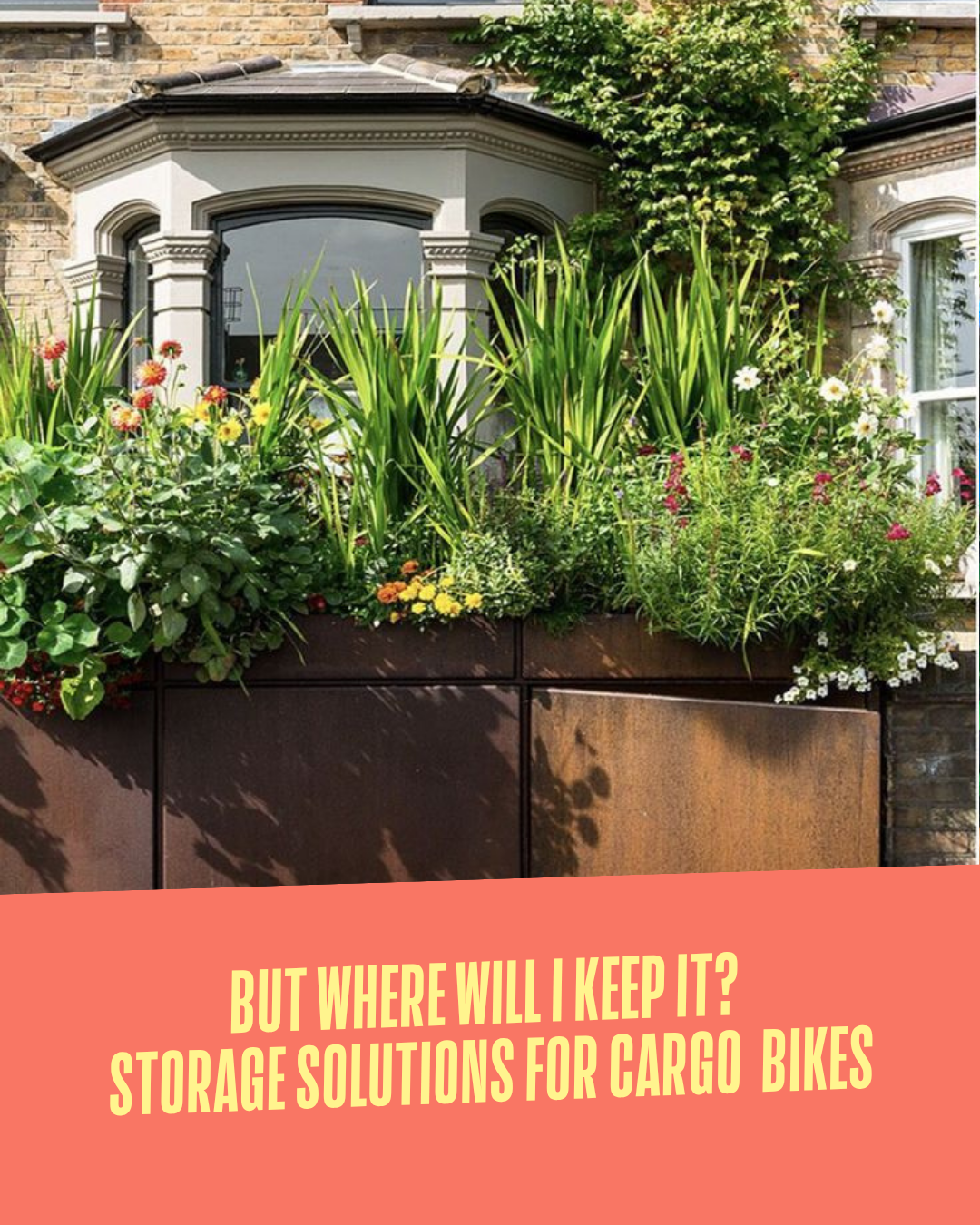
The Shed Route: You’ll need a specialist unit like those from Bike Shed Company, Asgard or the very cool London-based Bike Box, pictured above, which is part bike shed, part front wall.
Check if you need consent: in some areas, anything substantial in your front garden may require planning permission, particularly in Conservation Areas.
And don’t underestimate the front garden as a solution. Some families are going beyond simple sheds and integrating bike storage into attractive garden redesigns. It doesn’t have to look utilitarian.
The Ground Anchor: If a shed is too bulky or your front garden is shared among neighbours, a Sold Secure Diamond-rated ground anchor bolted into concrete is the gold standard. Pair this with a serious chain or lock.
Things to consider:
Remove the display and battery and keep them indoors.
Check your insurance terms carefully, some insurers can be particular about bikes stored outside or in sheds, including how many locks are needed, whether a space qualifies as private storage or whether bikes are kept out of sight.
2. The “Ground Floor” Life
If you live on or have access to a ground floor, the ‘hallway park’ might be an option.
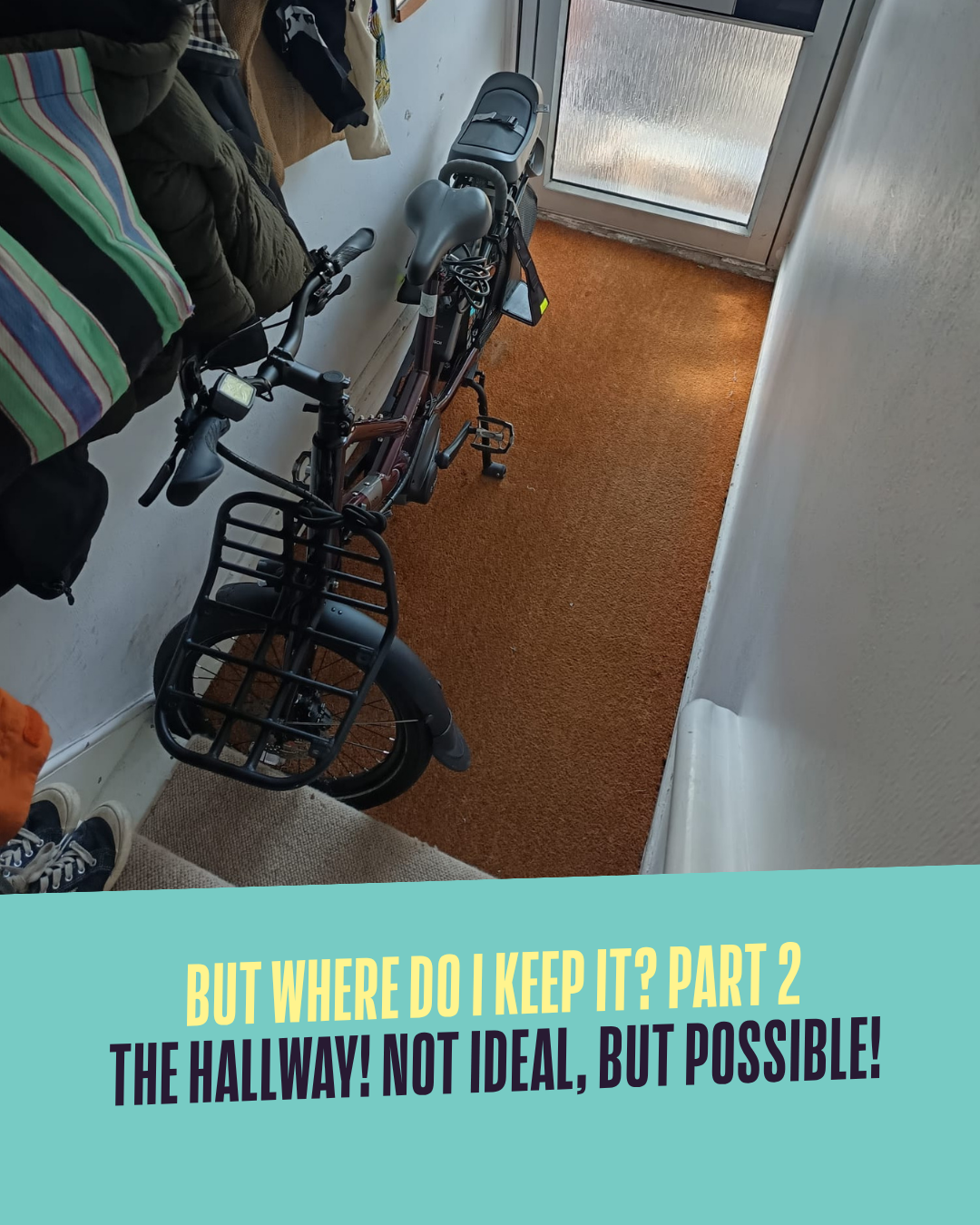
Yes, you may have to make peace with scuffed walls and doors, but nothing beats a warm saddle on a rainy day.
Most cargo bikes are heavy, so consider whether taking one up even a few steps is possible for you. Walk assist can help, and removable ramps can be an option.
Some longtails, like the Tern GSD, can “park on their tail” to save space; this means they can be pulled upright, so they securely balance on their back wheel. However, most other longtails and front-loaders are strictly horizontal, so measure carefully.
One important point
Make sure hallway storage does not obstruct an escape route in case of fire. You need to be able to get out quickly, and others in the building may rely on that route too. In shared corridors or common areas, there may also be building rules or fire safety restrictions on storing bikes, so it is worth checking.
3. On-Street Parking
If none of the options above are available, parking on the street could still be a workable everyday option.
With a loud alarm, serious locks, GPS and good insurance, many families do it. As with parking in a front garden, it is worth removing both the battery and the display whenever the bike is left unattended.
A tip we have heard from several community members is to use a cargo bike cover, something like a BikeParka or even a motorcycle cover. We sometimes call it the Harry Potter invisibility cloak.
Yes, it protects the bike from the weather. But some riders also feel it makes the bike less visually tempting, giving the impression there may just be an old abandoned motorcycle underneath rather than a valuable cargo bike.
It is not a substitute for proper security, but think of it as an extra layer of deterrence.
There are a couple of other things worth knowing: some insurance policies may only cover outdoor parking if the bike is kept unattended for a maximum of 18-24 hours. In practice, that may work for daily life, but not if you’re away on holiday.
So if on-street parking is your solution, it may be worth having a backup plan for longer absences, for example a secure commercial facility or bike hub with CCTV (see paragraph 5 below).
Also, check your insurance for relevant requirements around distance from home and how many locks are needed when storing a cargo bike away from home overnight. For example, Laka Collective requires two locks with at least one locked to an immovable object.
4. The Council Hangar
You’ve seen the green “bread bins” (Cyclehoops or Falco) on almost every corner. Unfortunately, most standard hangars don’t really work for cargo bikes.
Compact longtails may sometimes squeeze in, but regular longtails and front-loaders won’t. The good news is that dedicated cargo bike hangars exist and are beginning to be trialled. There are currently only two in London, so it’s probably not something you can depend on yet. But it is always worth asking your council for one.
One member of our community, together with neighbours, reported asking Camden Council for a cargo bike hangar on their street, and it now looks likely one will be installed. We have heard a similar tale in Southwark.
That is worth remembering: sometimes the solution doesn’t exist until someone asks for it. Check your council’s website for how to request a cargo bike hangar where you live.
5. Third-Party Saviours
If home storage is a flat “no”, look at third-party lockers and secure hubs.
Companies like Spokesafe have been repurposing underused urban spaces into secure bike hubs, often with wider bays specifically for cargo bikes. These can be especially useful as either a permanent solution if you live (or work) close to one or a holiday backup if you usually park on the street.
6. Foldable Cargo Bikes
If space is really tight, foldable cargo bikes are an increasingly interesting option. We’ve recently discovered the Car.los foldable cargo bike, whose clever design can significantly reduce storage challenges, making hallway or indoor storage far more realistic. It’s new territory, but it could be a game changer, not just for storage, but also for taking your bike on the tube or overground.
Security & Insurance: The Non-Negotiables
Especially if you keep your bike outside overnight, security matters.
Insure your bike, whether via specialist bike insurers or home contents insurance.
Use up to two Sold Secure Diamond-rated locks such as the Hiplok D1000 or Litelok X3.
Lock to something genuinely immovable.
Remove the battery and display as they are both expensive parts. For bikes with a Bosch motor and battery system, removing the display may offer an extra security benefit. Some Bosch systems include a digital lock feature, which disables both battery and motor assistance unless the authorised display or phone is reconnected. This can act as an additional deterrent, though it requires a paid subscription.
Final thoughts
Yes, cargo bikes take more thought to store than standard bikes.
But people make it work: in hallways, front gardens, hangars, and secure hubs.
So don’t let storage lock you out of the cargo bike life.
Because once you have one, you may find yourself asking not where do I put it? but how did we ever manage without it?
